Preview: nothing is saved
How a metronome works
One more look at what you missed.
A mechanical metronome is a swinging rod that ticks.
The rod, called a pendulum, swings left and right. It ticks once on every swing, left or right, and each tick is one beat.
One tick, one beat.
At 60 BPM each swing, from one side to the other, takes one second.
No sound? Check your volume, and that your phone is not on silent.
A sliding weight on the rod sets the speed.
Slide the weight up and the rod swings more slowly. Slide it down and it swings faster.
You slide the weight up the rod. What happens to the tempo?
Why: a weight far from the pivot swings slowly.
The rod turns on a pivot low in the case. The higher the weight sits, the longer each swing takes.
The scale behind the rod gives the tempo.
Slide the weight to a mark on the scale, and that mark is the BPM.
Try See inside and Open back to find the spring and gears. Then press Begin challenge and tap.
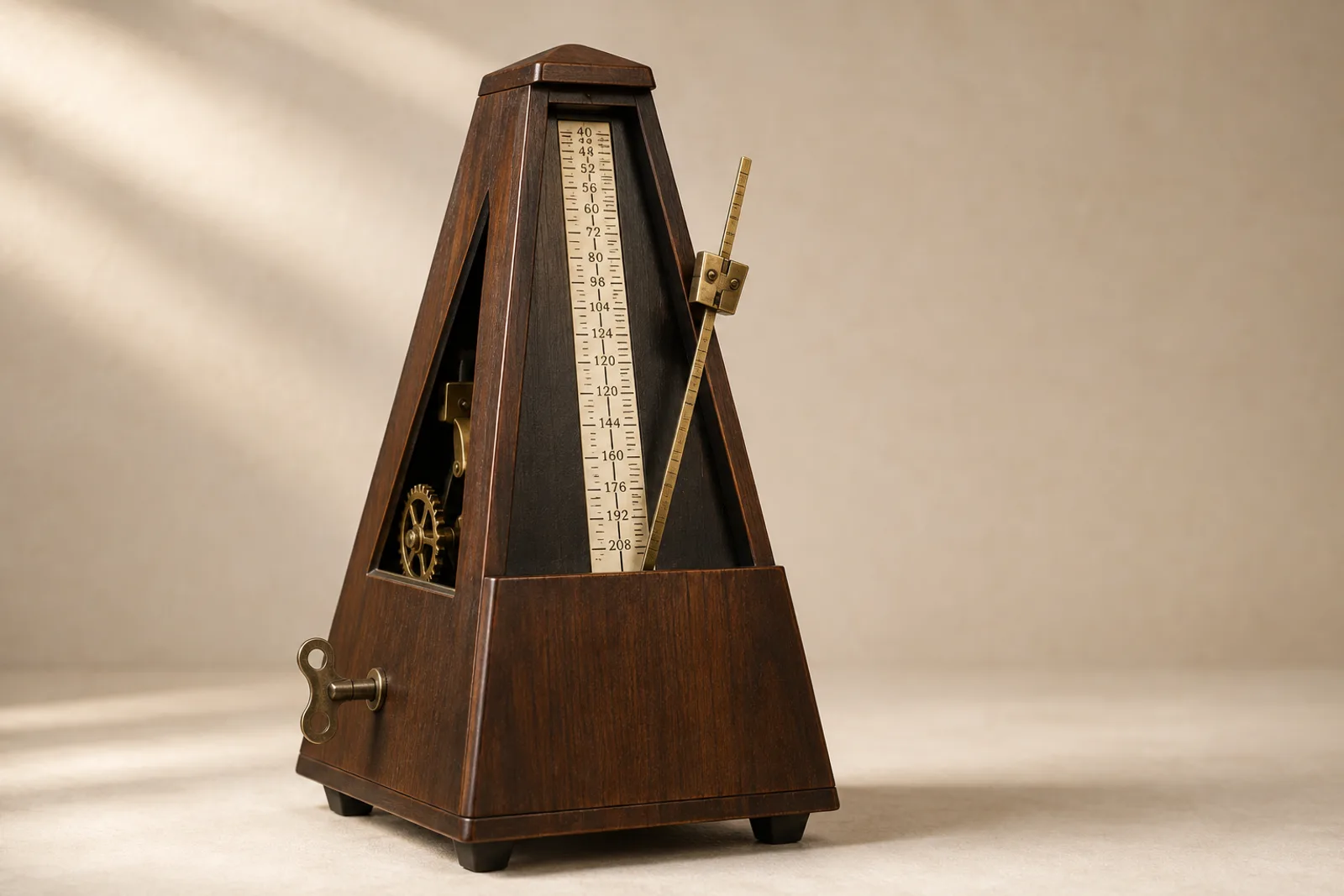
Front view of a mechanical metronome with its pendulum and tempo scale.
Loading the interactive metronome…
Inside, a wound spring keeps it going.
Turning the key winds a spring. Gears and a part called the escapement pass its energy to the rod in small, even pushes.
Which part sets how fast a metronome ticks?
You know how a metronome keeps time.
What you learned
- A swinging rod, the pendulum, ticks once for every beat.
- Slide the weight up for slower, down for faster.
- A wound spring and the escapement keep the swing going.
Your streak: 0 days
Out of stars for this step.
Each try makes the next one easier.